
Cologne vs Perfume: Understanding the Real Differences
Discover the true differences between cologne and perfume, from concentration levels to historical origins and modern marketing conventions.
Quick Answer
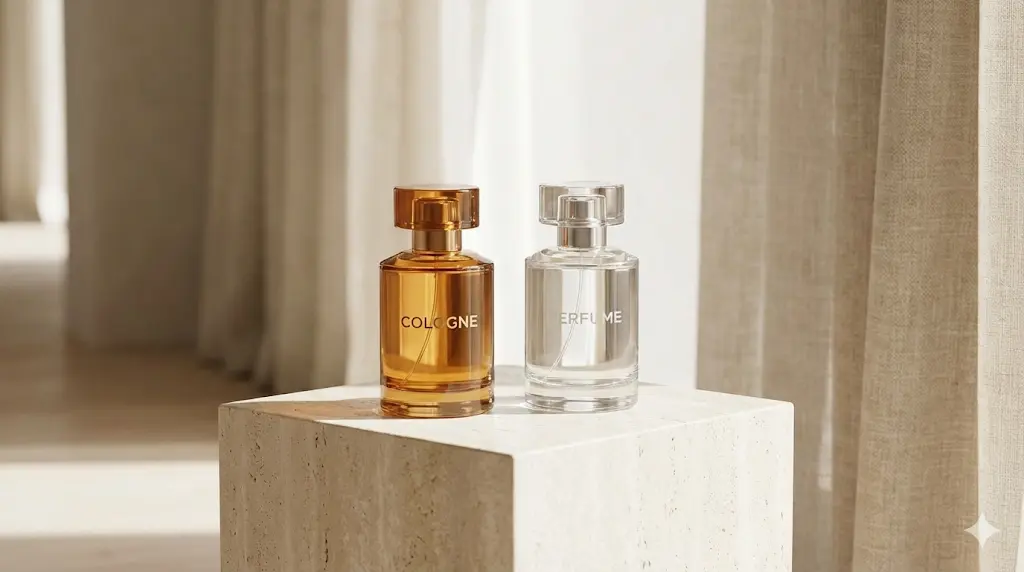
Technically, cologne (Eau de Cologne) refers to a low concentration fragrance (2-5% oils) originating from Cologne, Germany, while perfume encompasses all fragrances or specifically means high-concentration Parfum (20-40% oils). In American English, cologne became shorthand for "men's fragrance" and perfume for "women's fragrance," but this is marketing convention, not technical reality. Fragrances are not inherently gendered. Choose based on concentration level, scent profile, and personal preference rather than gendered marketing labels.
Walk into any department store and you will find separate sections for "cologne" and "perfume," typically divided by gender. The implicit message is clear: cologne is for men, perfume is for women. This division shapes how millions of people shop for fragrance, yet it represents one of the biggest misconceptions in the industry. The truth is more nuanced, more interesting, and more liberating for fragrance shoppers. Cologne and perfume are technical terms referring to fragrance concentration levels, not gender-specific product categories. Understanding this distinction opens up a world of scents that arbitrary marketing boundaries have artificially restricted. This guide traces the origins of both terms, explains their technical meanings, examines how marketing transformed them into gendered categories, and empowers you to shop based on what actually matters: how a fragrance smells on your skin and makes you feel.
The Historical Origins
To understand how cologne and perfume became gendered terms, we need to travel back several centuries to trace how these words originated and evolved.
1.1The Birth of Eau de Cologne
In 1709, Italian perfumer Giovanni Maria Farina created a fragrance in the German city of Cologne (Koln) that he named after his adopted hometown. This "Acqua di Colonia" or "Eau de Cologne" featured a revolutionary light, fresh composition built around citrus oils, neroli, and bergamot, a dramatic departure from the heavy, musky fragrances popular at the time. Farina's creation became wildly popular among European aristocracy. Napoleon Bonaparte reportedly used 60 bottles per month. The formula was so successful that the term "Eau de Cologne" eventually became both a brand name for Farina's products and a generic term for any similarly light, citrus-based fragrance. By the 19th century, "cologne" had evolved beyond its specific origins to denote a concentration level: light, fresh fragrances with relatively low oil content (2-5%). The term carried associations of freshness, cleanliness, and daytime appropriateness.
1.2The Evolution of Perfume
"Perfume" derives from the Latin "per fumum" meaning "through smoke," referencing ancient practices of burning aromatic materials. The term has been used for thousands of years to describe fragrant preparations, predating modern perfumery by millennia. In technical fragrance terminology, "Parfum" or "Perfume" refers to the highest concentration level: 20-40% fragrance oils in an alcohol base. This concentration provides the richest, longest-lasting scent experience. However, "perfume" also functions as a general term for any scented liquid applied for personal fragrance, regardless of concentration. This dual meaning, both a specific concentration and a general category, contributes to the confusion surrounding the term. Historically, concentrated perfumes were luxury items accessible only to the wealthy, while lighter preparations like Eau de Cologne offered a more affordable alternative. This class distinction would later morph into a gendered one.
1.3How Gender Entered the Equation
The gendering of fragrance terms is a relatively modern phenomenon, largely driven by 20th-century marketing rather than historical usage or technical necessity. In the early 1900s, American marketing departments began positioning lighter, fresh fragrances as "men's cologne" and heavier, floral fragrances as "women's perfume." This distinction served commercial purposes: it doubled the addressable market by convincing each gender they needed separate products and prevented sharing within households. Department stores reinforced this division with separate fragrance counters, different packaging designs (dark bottles and angular shapes for men, curved bottles and light colors for women), and gendered advertising imagery. By mid-century, the equation was firmly established in American consumer consciousness: cologne equals men's fragrance, perfume equals women's fragrance. This usage became so dominant that the technical concentration meanings faded from public awareness. European markets retained more of the traditional terminology, still using Eau de Cologne, Eau de Toilette, and Parfum as concentration indicators regardless of intended gender.
Technical Definitions: What the Terms Actually Mean
Setting aside marketing conventions, here is what cologne and perfume mean in technical fragrance terminology:
2.1Cologne (Eau de Cologne)
Technically, Eau de Cologne is a fragrance concentration containing 2-5% aromatic compounds in an alcohol and water base. This light concentration produces fragrances that: - Last 2-3 hours on skin - Project modestly, staying close to the body - Feature predominantly citrus and light aromatic notes - Require more frequent reapplication - Feel refreshing and invigorating Classic Eau de Cologne compositions lean heavily on bergamot, lemon, orange, neroli, and light herbs. They evoke cleanliness and freshness rather than seduction or mystery. Modern examples include 4711 Original Eau de Cologne (the oldest continuously produced fragrance in the world), Acqua di Parma Colonia, and many "body splash" products that use the EDC concentration.
2.2Perfume (Parfum / Extrait)
Parfum, the technical term for perfume at maximum concentration, contains 20-40% aromatic compounds. This produces fragrances that: - Last 8-12+ hours on skin - Project powerfully from minimal application - Reveal full complexity of top, heart, and base notes - Require only 1-2 sprays per application - Command premium pricing Parfum concentration allows perfumers to express their fullest artistic vision, with heavy base notes given enough concentration to project alongside lighter components. Examples include Chanel No. 5 Parfum, Guerlain Shalimar Extrait, and many niche offerings from houses like Roja Dove, Xerjoff, and Initio.
2.3The Spectrum Between
Between Eau de Cologne and Parfum sit the concentrations most people actually purchase: Eau de Toilette (5-15%): The workhorse concentration for most commercial fragrances, offering 3-5 hours of wear with moderate projection. Eau de Parfum (15-20%): Premium concentration providing 6-8 hours of wear with stronger projection. Most fragrances marketed as "men's cologne" are actually Eau de Toilette concentration, not true Eau de Cologne. The marketing term diverged from the technical term decades ago.
The Gender Marketing Myth
Here is the liberating truth that fragrance marketing does not want you to know: there is nothing inherently masculine about "cologne" scents or feminine about "perfume" scents. The gendered division is commercial construction, not olfactory reality.
3.1Notes Are Not Gendered
Aromatic compounds have no gender. Bergamot does not know if it is being sprayed on a man or woman. Vanilla does not check your identification before smelling delicious. The notes traditionally associated with "masculine" fragrances, such as woods, leather, tobacco, and spices, appear throughout historical perfumery for all genders. Women in the 1920s loved Guerlain Jicky with its heavy lavender and animalic notes. Men in the 18th century wore rose-heavy fragrances that modern marketing would label "feminine." The current gender associations are specific to late 20th century Western marketing, not universal truths about fragrance. Japanese fragrance culture, for example, draws different gender lines. Middle Eastern traditions assign different meanings to the same notes. When we say a fragrance "smells masculine" or "smells feminine," we are really saying it matches our culturally conditioned expectations, expectations that vary by place and time.
3.2The Commercial Logic of Gendering
Why did the fragrance industry embrace gender segregation so thoroughly? Simple economics: Gender separation doubles the market. Instead of households sharing one fragrance, each partner needs their own gender-appropriate bottle. It prevents cross-shopping. A man browsing the "women's" counter might face social discomfort, limiting his exposure to potentially perfect fragrances. It simplifies marketing. Gendered advertising can lean into stereotypes (flowers and romance for women, sports and seduction for men) rather than educating consumers about actual fragrance qualities. It drives gift purchasing. Clear gendered categories make it easy for gift-givers to shop with confidence, even without knowing the recipient's actual preferences. This commercial logic created and maintains the cologne/perfume gender split, not any inherent property of the fragrances themselves.
3.3Breaking the Binary
The fragrance industry has slowly begun acknowledging the artificiality of gendered marketing. "Unisex" and "genderless" lines have emerged, though they often represent a separate third category rather than questioning the fundamental division. Niche fragrance houses largely abandoned gendered marketing years ago. Creed, Le Labo, Maison Francis Kurkdjian, and similar brands present their fragrances as suitable for anyone who enjoys them. Some major designers are following suit. Tom Ford's Private Blend collection is explicitly unisex. Chanel has repositioned Bleu de Chanel as "for him" but has never suggested women cannot wear it. The most progressive view, embraced by fragrance enthusiasts worldwide, is that all fragrances are genderless by default. Wear what smells good on your skin and makes you feel confident, regardless of which counter displays it.
Practical Implications for Fragrance Shopping
Understanding the true meanings of cologne and perfume changes how you should approach fragrance shopping:
4.1Look Beyond the Gendered Counters
If you are a man who has only ever shopped the "men's cologne" section, you have artificially limited your options. Some of the best-performing fragrances for men technically sit on the women's counter simply because they lean floral or sweet. Similarly, women who want something "stronger" than typical perfumes often find perfect matches in the "men's section" among woody-spicy compositions. Ask yourself what notes and profiles you enjoy rather than what gender the marketing targets. Then shop accordingly, browsing both sections or seeking unisex options.
4.2Focus on Concentration, Not Category
When shopping, the concentration level (EDC, EDT, EDP, Parfum) tells you more useful information than whether something is labeled cologne or perfume. If you want something light for summer: seek lower concentrations (EDC, EDT) regardless of marketing category. If you want something lasting for evening: seek higher concentrations (EDP, Parfum) regardless of marketing category. If you find a "women's perfume" whose scent you love but want less intensity, check if it comes in EDT concentration. If a "men's cologne" is not lasting long enough, see if an EDP version exists.
4.3Trust Descriptions Over Labels
When researching fragrances, focus on the actual note descriptions and user experiences rather than gendered marketing language. A "masculine" fragrance described as featuring bergamot, lavender, and cedar might work beautifully on anyone who enjoys those notes. A "feminine" fragrance built around vanilla, amber, and musk might be exactly what a man seeking a cozy evening scent needs. Read what the fragrance actually contains and smells like, not what demographic the brand wants to sell it to.
Modern Trends in Gender and Fragrance
The fragrance industry is slowly evolving beyond strict gender binaries, driven by changing consumer preferences and cultural shifts toward gender fluidity.
5.1The Rise of Unisex Fragrance
Unisex fragrances have grown from a niche category to a major market segment. CK One in 1994 pioneered the mass-market unisex approach, and brands like Le Labo (Santal 33), Byredo, and Escentric Molecules have built their entire identities around genderless scent. These fragrances typically occupy middle ground in the traditional gender spectrum: not overtly floral (coded feminine) nor aggressively woody/leathery (coded masculine). They often emphasize musks, clean woods, and abstract molecular notes that lack strong gender associations. The unisex category legitimizes the idea that fragrance need not be gendered, even if it sometimes creates a limiting third category rather than eliminating categorization entirely.
5.2Consumer-Led Change
Fragrance enthusiast communities online have long ignored gendered marketing. On forums and social media, people of all genders share recommendations across traditional boundaries, celebrating fragrances for their quality rather than their target demographic. This community knowledge is filtering into mainstream consciousness. More consumers now feel comfortable crossing the gendered aisle, asking for samples of "women's" fragrances as men or vice versa. Younger generations show particular willingness to ignore traditional fragrance gender rules, having grown up in a culture more accepting of gender fluidity generally.
5.3Brand Responses
Some brands have responded to these shifts by: Launching explicitly genderless lines alongside traditional gendered offerings (Tom Ford Private Blend, Dior Privee). Reducing gendered language in marketing while keeping separate product lines. Designing new launches as unisex from conception rather than retroactively repositioning. Featuring gender-diverse models and spokespeople in advertising. The pace of change varies dramatically between brands and markets. European and niche brands generally lead, while mass-market American brands often lag, but the direction of travel seems clear.
A Framework for Choosing Fragrance Beyond Gender
Given that gendered labels provide minimal useful information, here is how to actually choose fragrance: Identify your preferred note families: Do you gravitate toward citrus and fresh notes? Woods and amber? Florals? Spices? Your preferences across these families matter far more than any gender label. Consider your use cases: What occasions and environments will you wear fragrance? Office-appropriate and date-night appropriate fragrances differ in projection and profile, but not by gender. Test on your own skin: Your body chemistry determines how any fragrance smells on you. A fragrance marketed to the opposite gender might smell incredible on your skin while a "same-gender" offering falls flat. Trust your nose: If you love how something smells, wear it. The fragrance police will not arrest you for crossing gendered boundaries. Build a collection based on function: Rather than "men's collection" or "women's collection," think in terms of fresh/casual, office/professional, evening/sexy, and special occasion. Fill each functional slot with whatever fragrance works best, regardless of marketing category. The result of this approach? A fragrance wardrobe that actually serves your life rather than your marketing demographic.
In This Guide
Recommended Fragrances
Tom Ford
Tobacco Vanille
From the explicitly unisex Private Blend collection, this warm, opulent fragrance transcends gender categories through sheer quality.
Maison Francis Kurkdjian
Baccarat Rouge 540
A modern classic worn by all genders, demonstrating that exceptional fragrance needs no gender designation.
Creed
Aventus
While marketed toward men, Aventus has a significant female following who appreciate its fruity-smoky profile.
Tom Ford
Oud Wood
Another unisex Private Blend that showcases how sophisticated woody fragrances work beautifully on any wearer.
Dior
Sauvage EDP
Though marketed as masculine, Sauvage EDP is regularly worn and appreciated by women who enjoy its fresh-spicy profile.
Frequently Asked Questions
No. Technically, cologne (Eau de Cologne) is a light fragrance concentration (2-5% oils) that can be worn by anyone. The association of cologne with men is an American marketing convention from the 20th century, not a technical requirement. Classic Eau de Cologne formulas from houses like Acqua di Parma are explicitly unisex.
Absolutely. Men have worn perfume throughout most of human history. The idea that perfume is exclusively feminine is a recent marketing invention. Many high-concentration Parfums are designed for or worn by men, and the fragrance enthusiast community widely embraces cross-gender wearing.
Aftershave is a post-shave product containing antiseptic and soothing ingredients, often with light fragrance. Cologne refers to a fragrance concentration level (Eau de Cologne) or, colloquially, any men's fragrance. Aftershave is applied after shaving for skin care; cologne is applied for scent and can be used regardless of shaving.
Women's perfumes often use higher concentrations (EDP or Parfum) compared to men's EDTs, requiring more costly fragrance oils per bottle. Additionally, marketing positions women's fragrance as luxury, commanding premium pricing. The perceived value difference is partly genuine (concentration) and partly constructed (positioning).
Not at all. Unisex fragrances are simply designed without targeting a specific gender, often using note profiles that lack strong gendered associations. Many of the finest niche fragrances are unisex and come in high concentrations with exceptional quality. Unisex refers to marketing approach, not quality level.
Look for marketing that does not specify gender, check if it comes in neutral packaging, and read note descriptions for balanced profiles. However, any fragrance can be gender-neutral in practice. Test on your own skin and judge whether you enjoy it rather than relying on marketing categories.
Continue Learning
Eau de Parfum vs Eau de Toilette: The Complete Guide to Fragrance Concentrations
Learn the real differences between EDP and EDT concentrations, including oil percentages, longevity, projection, and when to choose each type.
How to Choose Cologne: A Step-by-Step Guide to Finding Your Signature Scent
Learn how to choose the perfect cologne with our expert guide covering skin chemistry, testing methods, seasons, and building your collection.
Fragrance Notes Explained: Understanding Top, Middle, and Base Notes
Master the fragrance pyramid with our guide to top, middle, and base notes. Learn how notes evolve, what each category includes, and how to read perfume compositions.