How to Apply Cologne Properly: The Complete Guide to Perfect Application
Master cologne application with our expert guide covering pulse points, spray distance, optimal amounts, and the mistakes that ruin your fragrance.
Quick Answer
Apply cologne to pulse points (neck, wrists, chest) from 3-6 inches away using 2-4 sprays for most EDPs or 3-5 for EDTs. Never rub your wrists together as this breaks down fragrance molecules. Apply to clean, moisturized skin for best results. Reapply after 4-6 hours if needed, using half your original amount. Signs of over-application include people stepping back during conversation or commenting directly on your scent strength. Less is always more; you can add but cannot subtract.
You have invested in a quality cologne, perhaps spent considerable time researching and testing to find your perfect scent. But here is an uncomfortable truth: improper application can undermine even the finest fragrance, turning a sophisticated scent experience into an overwhelming assault on everyone around you or, conversely, leaving you wondering why nobody ever notices your cologne. The difference between a well-applied fragrance and a poorly applied one is dramatic. Proper technique creates a subtle, inviting scent aura that draws people in and leaves a memorable impression. Poor technique either repels people with excessive projection or wastes your investment through rapid evaporation and muted presence. This guide teaches you the professional approach to cologne application, from the optimal number of sprays to the precise locations on your body where fragrance performs best. You will learn why certain popular practices actually damage your fragrance, how to adjust application for different situations, and how to recognize when you have applied too much or too little. Whether you are wearing a daily office fragrance or preparing for a special evening occasion, these techniques will ensure your cologne works as the perfumer intended, enhancing your presence without overwhelming it.
Step 1: Prepare Your Application Surface
Before you even pick up your cologne bottle, the condition of your skin significantly impacts how well fragrance performs. Taking a few minutes to prepare properly can double your fragrance longevity.
1.1Shower and Clean Skin
Apply cologne to clean skin, ideally shortly after showering when your pores are slightly open and your body is warm. This creates optimal conditions for fragrance to bond with your skin. Avoid applying cologne over other scented products like heavily fragranced body wash residue, deodorant with strong scent, or aftershave balm. These competing scents can clash with your cologne and muddy the overall impression. If you cannot shower before application, at minimum ensure the areas where you will spray are clean and free from sweat, sunscreen, or other products. A quick wipe with an unscented cleansing cloth works for touch-ups throughout the day.
1.2Moisturize First
Dry skin releases fragrance molecules quickly, shortening longevity significantly. Apply an unscented moisturizer to your application areas 5-10 minutes before cologne. Focus on: - The sides of your neck - Your chest - Your wrists and inner forearms - Any other pulse points you intend to target The moisturizer creates a hydrated base that fragrance oils can cling to. Think of dry skin as a hot sidewalk that evaporates water instantly, while moisturized skin is like damp soil that retains moisture for hours. Some enthusiasts apply a thin layer of petroleum jelly (Vaseline) to pulse points for maximum longevity. This creates an occlusive barrier that traps fragrance molecules against your skin. While too heavy for daily use for some people, this technique works excellently for special occasions when you need all-day performance.
Step 2: Master Proper Spray Technique
The way you physically spray cologne matters more than most people realize. Poor technique wastes product and reduces performance, while proper technique maximizes every spray.
2.1The Optimal Spray Distance
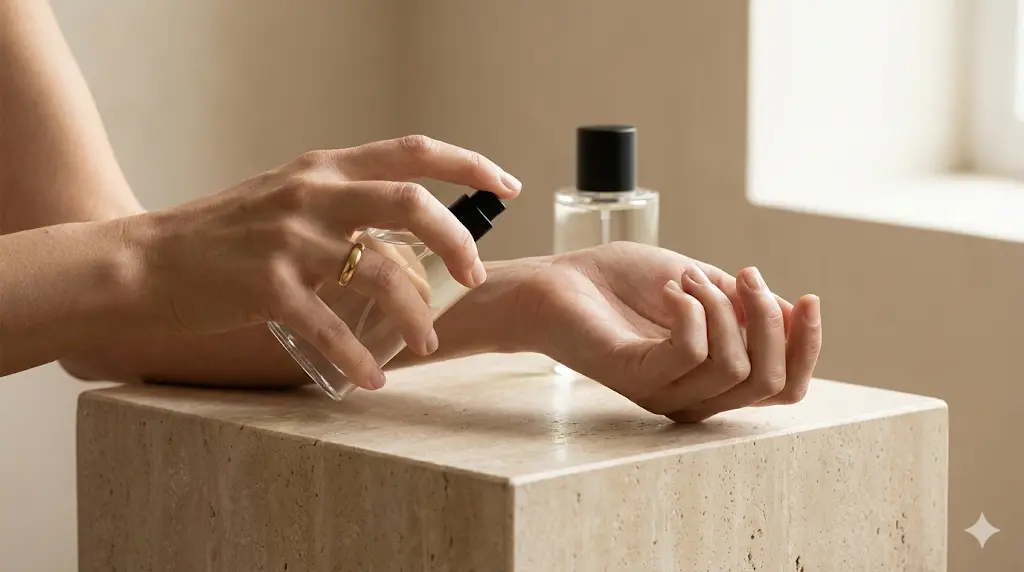
Hold the bottle 3-6 inches (approximately 8-15 centimeters) from your skin when spraying. This distance allows the fragrance to atomize properly and land as a fine, even mist rather than a concentrated wet spot. Why distance matters: Too close (under 3 inches): The fragrance concentrates in a small area, creating a wet spot that takes longer to dry and does not distribute the scent effectively. This concentrated application can actually reduce longevity because the fragrance is not spread across sufficient skin surface area. Optimal range (3-6 inches): The spray fully atomizes, creating a fine mist that settles evenly across your skin. This maximizes the surface area where fragrance can bond and release gradually. Too far (over 8 inches): Much of the fragrance disperses into the air before reaching your skin. You waste product and get less actual fragrance on your body. After spraying, you should see a light sheen on your skin, not visible droplets. If you see droplets, you sprayed too close.
2.2The Cardinal Sin: Never Rub Your Wrists Together
This is the single most important technique rule in fragrance application, yet the majority of cologne wearers violate it habitually. When you spray your wrists and rub them together, you: 1. Generate friction heat that accelerates evaporation of top notes 2. Break down delicate fragrance molecules through mechanical action 3. Crush the composition's intended evolution, distorting how it smells 4. Reduce overall longevity by damaging the fragrance structure The rubbing motion particularly destroys top notes, which are the lightest and most vulnerable components. This explains why fragrances often smell "different" or "flat" when people rub their application, as they have literally degraded the composition. Instead of rubbing: - Spray each wrist separately and let them air dry - If you want to transfer fragrance from wrist to another location, gently dab (press and lift) rather than rub - Simply be patient and allow 30-60 seconds for the fragrance to dry down naturally Breaking this habit can be challenging if you have rubbed your wrists together for years. Practice conscious application until the hands-apart approach becomes automatic.
2.3Spray Versus Dab Application
Most modern colognes come in spray atomizer bottles, which provide the best application method. The atomizer creates fine mist that distributes evenly and allows precise control over quantity. If your fragrance comes with a splash or dabber bottle (common with some vintage fragrances and Parfum concentrations): - Do not pour fragrance into your palm and slap it on, as this contaminates the bottle with skin oils and bacteria - Tip the bottle against your finger or a cotton pad, then gently dab onto pulse points - Use less than you think you need; concentrated splash fragrances are potent - Consider purchasing a separate atomizer and decanting some fragrance for easier daily application Spray application remains superior for most people because it provides consistent, measurable doses and even distribution. If you receive a non-spray bottle as a gift, decanting into a spray atomizer is a worthwhile investment.
Step 3: Target the Right Locations
Where you apply cologne determines how it projects, how it evolves, and how others perceive it. Strategic placement on pulse points maximizes performance.
3.1Understanding Pulse Points
Pulse points are areas where blood vessels run close to the skin surface, generating warmth that helps fragrance molecules volatilize and project. These warm zones continuously radiate scent throughout the day. Primary pulse points for cologne application: The sides of the neck: The most important application zone for most colognes. Warmth from your carotid arteries projects fragrance upward toward your face and outward toward others in conversation. Apply to the sides, not the front of your throat. The wrists: Classic application points that work well for personal enjoyment since you naturally bring wrists near your face. Less effective for impressing others unless you are in close physical contact. The chest: Particularly effective if you wear open-collar shirts or clothing that allows scent to escape. The warmth from your chest projects fragrance upward throughout the day. Apply to the upper chest area. Behind the ears: Small, warm areas that project well in intimate settings. Excellent for date scenarios where someone might lean in close. Apply sparingly as these areas are near the face. Inner elbows: Often overlooked but excellent performers. Fragrance here releases when your arms move naturally and stays protected from environmental factors. Good longevity zone. The key is selecting 2-3 locations rather than applying to all possible points. Over-application across every pulse point creates an overwhelming cloud rather than an attractive scent aura.
3.2Recommended Application Patterns
For most daily situations, these application patterns provide optimal results: Professional/Office Setting: - 1-2 sprays to the chest (under your shirt) - 1 spray to the back of the neck - Total: 2-3 sprays - Goal: Subtle presence detectable only in close conversation Casual Day Wear: - 1 spray to each side of the neck - 1 spray to the chest - Optional: 1 spray to one wrist - Total: 3-4 sprays - Goal: Noticeable personal scent with moderate projection Evening/Social Events: - 1-2 sprays to each side of the neck - 1 spray to the chest - 1 spray to each wrist or inner elbow - Total: 4-5 sprays - Goal: Confident presence with stronger projection Date Night/Intimate: - 1 spray to each side of the neck - 1 spray behind each ear - 1 spray to the chest - Total: 4-5 sprays - Goal: Inviting sillage that draws someone closer These are starting points. Your specific fragrance concentration, skin chemistry, and environment should guide adjustments. When in doubt, start with fewer sprays; you can always add more later, but you cannot remove over-application.
3.3Clothing Application
Spraying cologne on clothes can extend longevity dramatically since fabric holds fragrance molecules longer than skin. However, this technique requires caution. Safe clothing application: - Spray from at least 6-8 inches to create fine mist - Target inner collar areas, upper chest of shirts, inside jacket lapels - Stick to sturdy, dark fabrics that hide any potential marking - Avoid silk, leather, suede, and delicate fabrics that can stain or degrade - Test on inconspicuous areas first with new fragrances The trade-off with clothing application is that you miss the dynamic evolution fragrances undergo on skin. The scent remains more static, closer to opening/heart notes without the full dry-down development. Many enthusiasts apply to both skin and clothing: skin for the evolving scent experience and close-range intimacy, clothing for extended longevity and ambient projection. Hair also holds fragrance well, though direct application can dry hair over time. Spray a brush and run it through your hair, or spray fabric near your hair, rather than spraying directly onto your head daily.
Step 4: Get the Quantity Right
The number of sprays depends on concentration, specific fragrance, intended environment, and personal preference. These guidelines provide starting points for calibration.
4.1Application by Concentration
Different concentration levels require different application amounts: Eau de Cologne (2-5% concentration): - 5-7 sprays for noticeable presence - Short longevity means you may need to reapply - Can be applied more liberally due to lightness Eau de Toilette (5-15% concentration): - 3-5 sprays for moderate projection - Lasts 3-5 hours typically - Most versatile application range Eau de Parfum (15-20% concentration): - 2-4 sprays for substantial presence - Lasts 6-8 hours typically - Exercise more restraint than with EDT Parfum/Extrait (20-40% concentration): - 1-2 sprays for powerful, lasting effect - Can last 8-12+ hours - Use sparingly; these are extremely concentrated These numbers represent maximums for social situations. Office environments and close-quarter scenarios often call for the lower end of these ranges.
4.2Environmental Adjustments
Your environment should influence application quantity: Hot weather: Use 1-2 fewer sprays than normal. Heat amplifies projection significantly, so lighter application prevents overwhelming those around you. Cold weather: Can use 1-2 more sprays than normal. Cold suppresses projection, so heavier application compensates. Humid climate: Often amplifies projection like heat. Reduce quantity accordingly. Air conditioning: If you spend most of your day in AC, normal application usually works well since the environment is controlled. Indoor social events: Standard to slightly reduced application. You will be in close proximity to others for extended periods. Outdoor activities: Can apply more generously as scent disperses quickly in open air. Close-quarters (airplane, elevator, meeting room): Minimum application. Other people cannot escape your scent cloud, so err on the side of subtlety.
4.3Signs of Over-Application
How do you know if you have applied too much? Watch for these indicators: Immediate signals: - People step back slightly when you approach - Friends or colleagues comment on how strong your cologne is - You can smell yourself from arm's length without trying - The scent seems to "fill the room" when you enter Delayed indicators: - Headaches in yourself or those around you (fragrance-induced) - People avoiding close conversation - Direct requests to use less cologne (take these seriously) - Getting looks in elevators or close spaces The goal is a "scent aura" that extends about arm's length in normal conditions. People should notice your fragrance when they hug you or lean in close, not when they are across the room. Remember: you quickly become nose-blind to your own fragrance due to olfactory fatigue. Just because you cannot smell yourself after an hour does not mean others cannot. Trust your initial application and resist the urge to keep spraying just because you stopped noticing the scent.
Step 5: Timing and Reapplication
When you apply and whether you reapply can significantly impact your fragrance experience throughout the day.
5.1Optimal Application Timing
Apply cologne after you have completed the rest of your grooming routine, as the final step before dressing or as you dress: Post-shower timing: The best window is 5-15 minutes after showering, when skin is clean, warm, and freshly moisturized. Your pores are slightly open from the warm water, allowing better fragrance absorption. Before or after dressing: Either works, but applying before dressing allows fragrance to settle and dry before fabric contact. If applying after dressing, take care not to spray directly on clothing you want to protect. Time before leaving: Apply 10-15 minutes before you need the fragrance to perform. This allows volatile top notes to settle and the heart notes to begin emerging, presenting you with a more balanced scent rather than a blast of opening notes when you arrive at your destination. For events: If you have a specific event (date, meeting, party), time your application so the fragrance is in its heart note phase upon arrival. For most fragrances, this means applying 30-60 minutes before the event. You want people to experience the full, developed scent, not just the opening.
5.2When and How to Reapply
Reapplication extends your scent presence but requires care to avoid over-application: Typical reapplication timing: - EDT: 4-5 hours after initial application - EDP: 6-8 hours after initial application - Parfum: Usually does not need reapplication for single-day wear How to reapply: - Use half (or less) of your initial spray count - Focus on one or two pulse points, typically neck or wrists - Avoid layering heavily over existing application - A travel atomizer makes midday reapplication convenient When not to reapply: - Just because you cannot smell yourself (olfactory fatigue is normal) - In situations where you cannot confirm the first application has actually faded - When you will be in close quarters with others who have been around you all day A good approach: If you plan to need reapplication, carry a travel atomizer with 1-2 sprays worth. This provides a touch-up option without risk of heavy over-application. The ask-first method: If uncertain whether you need more, ask a trusted friend or colleague if they can still detect your fragrance. Their answer tells you whether reapplication is necessary or if your nose has simply adapted.
Common Application Mistakes to Avoid
Beyond the critical "no rubbing" rule, several other common mistakes undermine cologne performance.
6.1Spraying Into the Air and Walking Through
This popular technique wastes product and provides inconsistent application. When you spray a cloud and walk through it: - Most of the fragrance falls to the floor or disperses into the air - Very little actually lands on your skin or clothes - You have no control over where the fragrance deposits - Application is uneven and unpredictable This technique became popular in old Hollywood movies for dramatic effect, not for practical fragrance application. Direct spray to pulse points provides far better results with less waste. The only scenario where misting might have merit is for very strong fragrances where you want extremely light application. Even then, a single spray to one pulse point achieves better results.
6.2Storing Cologne in the Bathroom
While this is more about storage than application, bathroom storage degrades your cologne over time, making application less effective: - Temperature fluctuations from showers damage fragrance molecules - Humidity accelerates breakdown - Light exposure through windows causes photodegradation Store cologne in a cool, dark, temperature-stable location (bedroom drawer, closet) and bring it to the bathroom only for application. Your fragrances will maintain their intended performance much longer.
6.3Applying to Dry, Unprepared Skin
Spraying directly onto dry skin immediately after waking, without showering or moisturizing, significantly reduces longevity. The fragrance has no hydrated base to cling to and evaporates rapidly. Even when time is limited, a quick splash of water and dab of unscented moisturizer on application areas noticeably improves performance. The extra two minutes of preparation pays dividends in all-day wear.
6.4Letting Others Apply Your Cologne
When someone else sprays cologne on you, they typically over-apply because they cannot feel the spray landing and cannot gauge their distance properly. Politely apply your own fragrance to maintain control over quantity and placement.
In This Guide
Recommended Fragrances
Dior
Sauvage EDP
Forgiving of application technique due to strong projection, but rewards proper pulse point placement with balanced, long-lasting sillage.
Chanel
Bleu de Chanel EDT
The EDT concentration showcases how proper application can maximize a lighter fragrance, demonstrating technique importance clearly.
Versace
Dylan Blue
Strong projection benefits from restrained application to pulse points rather than liberal spraying. Excellent for learning proper quantity control.
Dolce & Gabbana
The One EDP
A close-wearing fragrance that demonstrates how neck and chest application creates an intimate scent aura perfect for conversation distance.
Yves Saint Laurent
Y EDP
Versatile office-to-evening fragrance that rewards moderate application with sophisticated, balanced projection throughout the day.
Frequently Asked Questions
For Eau de Parfum, start with 2-4 sprays; for Eau de Toilette, 3-5 sprays. Apply to pulse points like neck and chest. Factors like concentration, environment, and personal preference guide the exact number. Office settings call for fewer sprays while evening events can handle more. When in doubt, start with less. You can always add more, but you cannot remove over-application.
Focus on pulse points: sides of the neck (most important), chest, and wrists. These warm areas help fragrance project throughout the day. Avoid spraying directly on clothes (may stain) unless testing first. For intimate occasions, add a spray behind each ear. For office wear, chest application under clothing provides subtle presence.
Never rub your wrists together after applying cologne. Rubbing creates friction that breaks down fragrance molecules, damages top notes, and reduces longevity. Instead, spray each area separately and allow the fragrance to air dry naturally. If transferring from wrists to another area, gently dab rather than rub.
Apply cologne as the final step in your grooming routine, ideally 5-15 minutes after showering when skin is clean, warm, and moisturized. For events, apply 30-60 minutes beforehand so the fragrance develops into its heart notes by the time you arrive. Apply before dressing to avoid staining clothes.
EDT typically needs reapplication after 4-5 hours; EDP after 6-8 hours. Use half your original spray count when reapplying. Do not reapply just because you cannot smell yourself, as olfactory fatigue makes you nose-blind to your own scent. Ask someone else first, or trust your initial application for most situations.
Yes, but with caution. Fabric holds fragrance longer than skin, extending longevity significantly. Spray from 6-8 inches onto sturdy, dark fabrics in inconspicuous areas. Avoid silk, leather, and delicate materials that may stain. Test new fragrances on hidden areas first. The trade-off is missing the evolving scent experience that only skin provides.
Continue Learning
How to Make Cologne Last Longer: Proven Techniques for All-Day Wear
Maximize your fragrance longevity with proven techniques covering application, storage, layering, and choosing long-lasting cologne formulas.
Eau de Parfum vs Eau de Toilette: The Complete Guide to Fragrance Concentrations
Learn the real differences between EDP and EDT concentrations, including oil percentages, longevity, projection, and when to choose each type.
How to Choose Cologne: A Step-by-Step Guide to Finding Your Signature Scent
Learn how to choose the perfect cologne with our expert guide covering skin chemistry, testing methods, seasons, and building your collection.
How to Layer Fragrances: Create Your Unique Signature Scent
Master fragrance layering with our expert guide. Learn which scents combine well, avoid clashing combinations, and create unique signature scents.